
Latest Meeting Report:
Meeting Report of the Ipswich and District Historical Transport Society on May 27th 2026.
A creditable total of 59 members and visitors attended the final meeting of our season.
The subject of the talk at this meeting was: “Boat building in Ipswich.” Presented by our member: Chris Turland.
Shipbuilding went on in the Ipswich area from very early times and there were up to thirteen dockyards operating along the River Orwell during the intervening period. Examples were Harney’s and Bigod’s Quays. The Bigods were a rich Norman family and Earls of Norfolk. They built Orford Castle.
In 1295 King Edward II ordered galleys to be built by many of the major towns in England. Ipswich was then in that category. Barges towed King Edward’s ships from the Ipswich yards out to the Kingsfleet area off old Felixstowe.
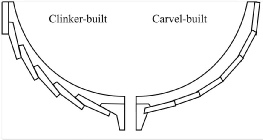
Galleys at that time were 100 feet long and carried 120 oars. They had masts 80 feet high and were therefore very impressive vessels. There were two main methods used to arrange the wooden planks making up the hulls of ships: clinker and carvel-built structures – as indicated in the diagrams.
The frame was introduced after the planking has been assembled in a clinker-built hull. In the carvel-built hull, the planks were nailed on to the frame.
The gaps between the planks on the latter type were caulked using oakum and tar to prevent leakage. Oakum was created by unpicking old tarred rope. In the nineteenth century this was a job done by the inmates of workhouses – a process that severely damaged their hands, poor souls.
Shipwrights in the early days would go out and mark the trees they required. Very often their wives would be employed to bring the felled trees back to the yard in hermaphrodite waggons. They used green oak because seasoned wood could cause unpredictable leakage problems when the hull was immersed in water.
Ship building continued in Ipswich but not without financial difficulties. Many went bankrupt – and some did so a number of times. The problems were mainly due to the big initial capital outlay. If a buyer let the builder down when the work was completed then the latter would face financial ruin. In an attempt to prevent this; local merchants often formed a consortium with the builder. Even so, there are many local records of yard contents being put up for sale because they had failed.
One Ipswich builder, a Mr Barnard, built what he described as an unsinkable lifeboat. It was said to have been taken to London but unfortunately, during tests, it struck a submerged wharf and sank without trace (RMS Titanic was not the first “unsinkable” ship). In 1778 John Barnard did initially make a considerable amount of money and owned pretty well all of the docks. He even built a seawater swimming pool on his property for local people to use. His company later failed, however, and he died soon after.
Obviously, considerable quantities of ropes were needed for these locally built ships. There are records of up to five rope walks in Ipswich. There was one, for example, running from the bottom to the top of Bishop’s Hill. Another ran up London Road hill. There was the one most know about, of-course, running through the road named Rope Walk in the town.
Some local firms built their own boats. Ransomes Sims and Jeffries built a paddle steamer on the quay outside their works. It was too heavy to move into the water; they therefore removed the engine and used cranes hired from Ransome and Rapiers to complete the transfer.
R and W Paul initially bought a lot of barges from the boat building firm of Orvis at Dock End Yard. Pauls had a angry dispute with Orvis over the costs and eventually built their own barges for the next ten years.
Baileys built the last round bottomed vessel. She was named Clementine
and she eventually travelled out to Newfoundland.
Orvis was still refitting ships at Dock End Yard as late as 1970.
Chris ended by taking questions from the audience. He received thanks from our Chairman and warm applause from the floor for an interesting talk on a local subject, from an enthusiastic speaker.
Mervyn Russen

- Chris Turland
Courtesy Chris Turland
Public Domain
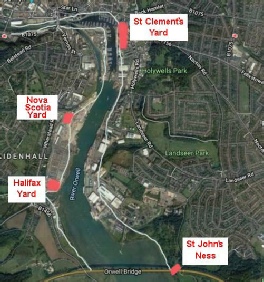
Aerial view of the dockyard showing the locations of boatyards as they were in John Barnard's day in the 1700's
Courtesy Chris Turland
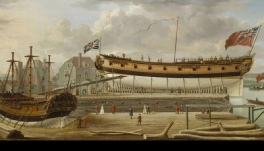
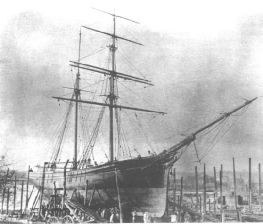
Ship under construction on the stocks in St Clement's Yard in 1758
Courtesy Chris Turland
The schooner "Clementine" built in Bailey's St Clement's Yard in 1885. It was the last round-bottomed trading vessel built in Ipswich. Shown here ready for launch
Courtesy Chris Turland